
SANOFEX
SANOFEX is a world leader in finding, mining and processing the Earth’s mineral resources. The Group combines SANOFEX Limited (‘SANOFEX’), a private New Zealand company to be listed on the New Zealand Stock Exchange, Ironsands Offshore Mining Limited (‘IOM’), which is a private operational asset, and four subsidiaries which are the owners of the operational leases. Namely, Pacific Offshore Mining Limited (‘POM’); Taranaki Offshore Mining Limited (‘TOM’); West Coast Offshore Mining Limited (‘WCOM’); and Kaipara Offshore Mining Limited (‘KOM’). We aim to operate as a seamless organisation that acts and looks like one company and maximises the benefits of standard and shared approaches for every activity.
The Group’s objective is to maximise its value and the long term return to shareholders through a strategy of investing in large, cost competitive mines and businesses driven by the quality of each opportunity. Major products are ilmenite, merchant pig iron, synthetic rutile, titanomagnetite, gold, industrial minerals such as zircon, fertilizer products such as thermo-potash and rock phosphate. Our activities are solely represented in New Zealand at the present time.
Wherever SANOFEX operates, the health and safety of our employees, and a contribution to sustainable development, are key priorities. We work as closely as possible with host countries and communities, respecting their laws and customs and ensuring a fair share of benefits and opportunities.
Introduction
This document provides details of the SANOFEX Health, Safety, Environment and Quality (HSEQ) management system standard, which is mandatory for all SANOFEX Group businesses. While the primary focus of this Standard is to manage health, safety and environmental performance, quality management has also been integrated to provide for businesses with quality programmes.
Managing health, safety and environment – the SANOFEX approach
Heath, safety and environmental issues present significant risks to SANOFEX, both to individual businesses and to the Group. To address these risks, SANOFEX has begun developing an HSE programme, whereby all Group businesses are required to meet the same standard of practice. Policies, strategies, standards, internal controls, performance indicators and targets, are developed centrally to help manage risk and improve HSE performance. This programme will support individual businesses to achieve their performance objectives as well as the Group as a whole. SANOFEX HSE policies and standards are mandatory and all Group businesses are required to implement them as part of the HSE development programme. However, businesses are encouraged to develop additional policies and approaches that can best meet their individual needs, operating environments and products.
Why does HSE need an integrated management system?
To ensure we have a common approach to managing HSE performance and achieve ongoing improvement across SANOFEX, we need to focus on the systematic identification, management and improvement of the areas of our business that can present risk. This approach applies to the management of health, safety and the environment across our business activities.Implementing one system (rather than having a number of individual systems to manage each area) brings together all requirements for quality, occupational health and safety and the environment. This enables us to:
• Centrally identify, evaluate and manage risk across the business.
• Centrally manage requirements for international standards certification.
• Rationalise resources.
• Reduce complexity.
• Improve performance.
• Maintain and enhance reputation.
Once implemented, an integrated management system helps businesses better develop their own policy, establish appropriate objectives and targets, implement processes to achieve policy commitments and take the required action to address risks and improve performance. It also provides a platform for them to be able to demonstrate ongoing conformance to the SANOFEX HSE standards.
How does the HSEQ management system standard work?
This Standard details the requirements for SANOFEX Group businesses to implement an integrated system for the management of health, safety, environment and, (where relevant) quality. It is designed on the principles of continual improvement and adopts the methodology of Plan, Do, Check and Review (Figure 1). The structure of the management system generally follows the layout of common international standards such as; ISO 14001, (Environment); OHSAS 18001 and AS/NZS 4801 (Health and Safety); ISO 9001 (Quality).
The management system standard is divided into seventeen elements. Each element
sets out to achieve a specific objective that enables the business to best identify and manage its various HSEQ threats and opportunities. Every element includes a number of clauses, which spell out the minimum requirements to meet each objective.
While all SANOFEX businesses must meet the requirements of this Standard, each business’s management system may differ depending on its needs. That is, the level of detail and complexity of the management system (and the extent of the documentation and resources devoted to it) depends on the nature and scale of the business activities. At all times, businesses are encouraged to take a pragmatic approach.
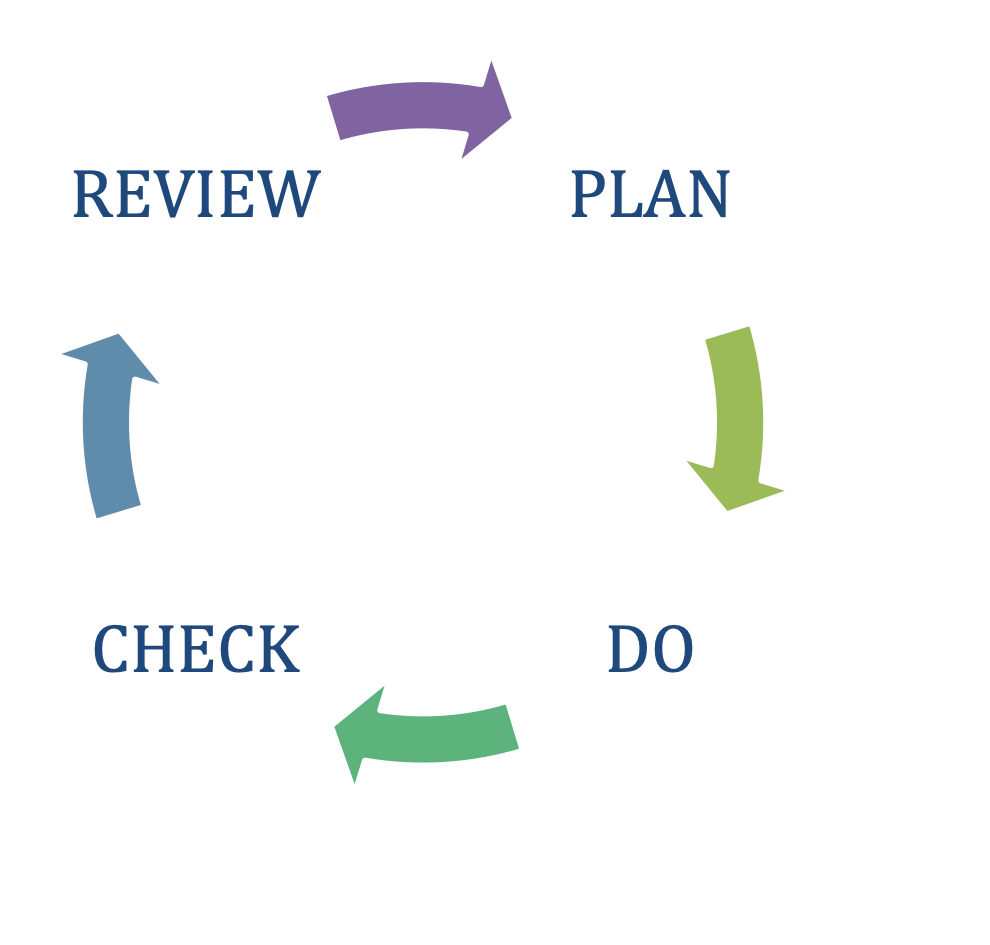
[Figure 1 – The SANOFEX HSEQ management system standard’s continual improvement cycle showing the four continuous cycle phases.]
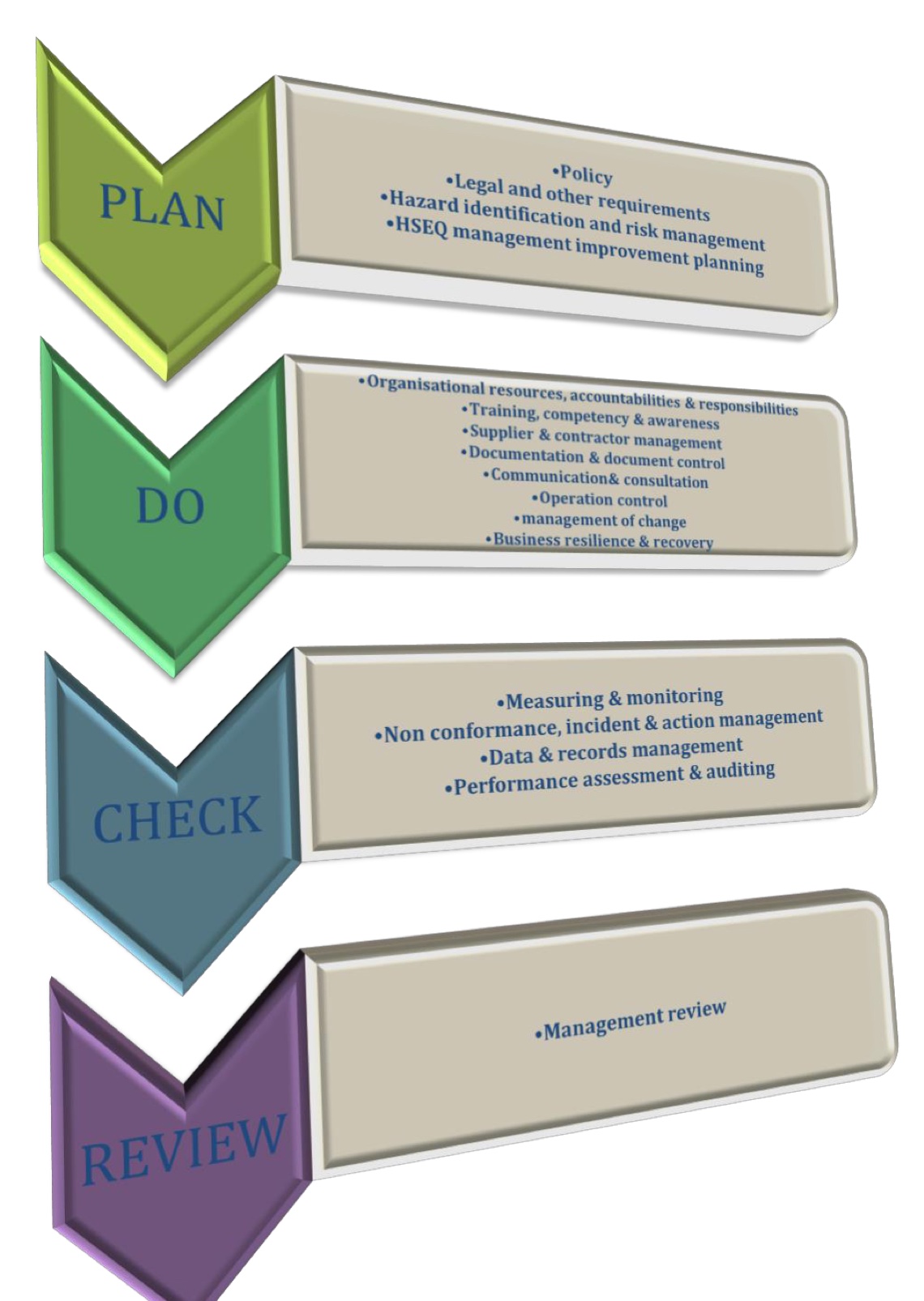
[Figure 2 – The SANOFEX HSEQ management system standard’s continual improvement cycle showing the four phases & the seventeen elements.]
Compatibility with certified international management systems
The SANOFEX HSEQ management system standard is working towards being consistent with ISO 14001, (Environment); OHSAS 18001 and AS/NZS 4801 (Health and Safety); ISO 9001 (Quality); and equivalent international standards. If a business or site’s management system conforms to the SANOFEX HSEQ management system standard, it will when completed comply with all the certification requirements of these international standards.
When ready SANOFEX will appoint a global certification provider to audit against the HSEQ management system standard and issue certificates relevant to the defined scope of the businessor site’s management system. The audit is to be conducted as part of the HSEQ business conformance audit programme.
Interpreting the Quality requirements
Wherever practicable, Quality management has been integrated into each requirement
of the Standard. Where Quality may be separated from HSEQ, because of a business scope or need, it has be placed in square brackets eg HSE[Q]. Standalone Quality management system requirements are identified by the symbol [Q] at the beginning of a clause.
A business may still elect to implement all or part of the Quality components of the Standard, alongside the mandatory HSE scope, and not seek certification to ISO 9001 as they recognise the benefits from integrating such practices into their business activities.
How to use this document
Throughout the Standard, references are made to supporting SANOFEX documents. These documents contain mandatory requirements and are notated in italics.
Modifications to this document are made periodically to ensure it is current.
If using a printed version of this Standard, always check to ensure the version you are using is current.
The Standard
Scope
All SANOFEX businesses, their managed sites and functional locations must implement, or demonstrate conformance to an integrated management system aligned to the requirements of this Standard.
Statutory and permitting requirements will take precedence over SANOFEX standards, except in those cases where the SANOFEX standards are more stringent.
Application
This Standard applies to:
(a) exploration and project development;
(b) conceptual studies (including projects of merit);
(c) order of magnitude studies;
(d) prefeasibility studies;
(e) feasibility studies;
(f) execution and construction;
(g) commissioning and ramp up;
(h) operating;
(i) care and maintenance;
(j) closure and rehabilitation;
(k) post closure;
(l) all contractor activities undertaken on SANOFEX sites or under SANOFEX management.
Newly acquired businesses or sites must conform to SANOFEX’s HSEQ management system standard by performing a gap analysis and by developing and starting to implement an action plan to close the gaps within six months. Within 24 months of an acquisition or sooner, newly acquired businesses and sites must achieve certification to ISO 14001 Environmental Management for their management system, and complete the implementation action plan.
SANOFEX expects business partners, such as associate companies or joint ventures where we do not have operating responsibility, as well as principal contractors, suppliers and others with whom it has a substantial involvement, to conform to comparable HSEQ management standards. SANOFEX informs them of these standards, its principles and policies and works with them where appropriate to support their adoption of practices consistent with our own.
SANOFEX businesses or managed sites in closure or under divestment must implement a process for the management and retention of records for future reference.
General requirements
The scope of the management system must be defined and documented.
Working towards certification to ISO 14001 Environmental Management; is mandatory.
Certification to additional international standards (OHSAS 18001; AS/NZS 4801; ISO 9001) is at the discretion of the SANOFEX business(es) implementing this Standard. Such decisions must be documented, and must form part of the scope of their management system.
[Q] Businesses with Quality programmes must ensure that the applicable scope of the HSE[Q] management system in relation to product realisation is documented and maintained.
Product stewardship: businesses, through the implementation of the requirements of this Standard, must demonstrate an understanding of the use and lifecycle of their products. They must develop and maintain the appropriate health and environmental data to allow for the safe use of their products in the workplace and by consumers.
Documentation: where the requirement for a procedure appears in this Standard, this means that a procedure is established, documented, implemented, communicated and maintained.
Non-implementation and variance
After defining the scope of the management system, a business may identify specific clauses of the standard that it will not implement as part of its system. If this is the case it must submit a non-implementation request.
A non-implementation request is a documented statement that justifies why the HSEQ management system’s clause(s) or other mandated standard or requirement is not applicable to the business and/or site.
Where a business recognises it cannot currently conform to an element or clause of the HSEQ management system standard or the HSE performance standards it may submit a variance request.
A variance is an action plan that either puts in place temporary controls to treat the
risk resulting from the non-conformance until such time as engineering or procurement issues can be resolved; or it details the process that the business is undertaking to obtain conformance.
Businesses may submit non–implementation or variance requests against whole standards, individual clauses or single scope requirements, such as all Quality components of the management system standard.
The process must be completed annually, and incorporated into the management review of the HSEQ management system to determine if it is still relevant to the business scope.
The SANOFEX HSE discipline leaders must approve a non-implementation statement and/or variance submitted by the business’ managing director before the business is audited.
Supporting SANOFEX references
SANOFEX The way we operate
SANOFEX Group Antitrust standard
SANOFEX Group Anti-Corruption standard
SANOFEX Group Climate position statement
SANOFEX Group Communities standard
SANOFEX Group Community complaints, disputes and grievances guidance
SANOFEX Group Cultural heritage management guidance
SANOFEX Group Employment Policy
SANOFEX Group Environment policy
SANOFEX Group Health policy
SANOFEX Group Human rights policy
SANOFEX Group Risk policy
SANOFEX Group Safety policy
SANOFEX Group Sustainable development policy
Supporting registers
Audit records register
Certification register
Compliance and conformance register
Hazardous materials register
Management review records register
Records (data) register
Requirements (legal and other) register
Risk register
Plan
Element 1: Policy
Objective:
Develop a policy that establishes a clear set of values and objectives for the effective management of health, safety, environment [and quality] (HSEQ) performance. It must be consistent with SANOFEX’s codes of business practice.
Clause 1.1
All SANOFEX businesses and their managed sites must develop, implement and maintain an integrated approach for the management of health, safety, and environment [and if relevant, quality]. Management approaches or ‘systems’ must follow this SANOFEX HSE[Q] management standard and include a policy that is appropriate to the nature and scale of the activities being managed.
The Policy must commit to:
The prevention of incidents that may lead to: injuries, illnesses, pollution, property and environmental damage, security threats, process losses and product quality impacts.
(b) Compliance with legal and other requirements, including international accords and external requirements to which SANOFEX or the business/activity subscribes.
(c) The effective management of HSE[Q] risks.
(d) Adopting leading practice in key HSE[Q] areas through continual improvement.
(e) Establishing measurable objectives and targets for improving HSE[Q] performance.
(f) Providing the resources needed to meet our performance objectives.
(g) Encouraging employee participation and promoting employee awareness of HSE[Q] threats and opportunities.
(h) Meeting customer requirements.
Clause 1.2
The Policy must be:
a) Documented.
b) Approved by senior management responsible for the site where it is to be implemented.
c) Communicated and made available to all relevant internal and external stakeholders and interested parties.
d) Periodically reviewed to ensure it reflects the needs and priorities of the business.
Clause 1.3
[Q] For businesses or managed sites where our customers require external recognition of our commitment to quality services and products, we are required to document, implement and maintain a management system so that:
a) It is in accordance with the international standard ISO 9001.
b) The processes required by the system (including management activities, resources, product realisation, measurement, analysis and improvement) are identified.
c) The sequence and interaction of these processes are documented and communicated.
d) The required controls and actions necessary to maintain these processes and meet planned performance are effective and allow for continual improvement.
Element 2: Legal and other requirements
Objective:
Comply with all legal and other HSE[Q] requirements. Conform to internal SANOFEX standards, policies and other obligations.
Clause 2.1
The business or site’s management system must conform with the requirements of, and seek to obtain a certification to ISO 14001 Environmental Management.
Clause 2.2
All applicable HSE[Q] legal and other requirements must be identified, evaluated for compliance and stored in a register.
The register must:
a) Define accountability for maintaining compliance or conformance to each requirement.
b) Be checked regularly for currency, and expiry/renewal dates.
c) Include or provide reference to records that show periodic evaluation of compliance.
d) Include relevant legislative obligations (international, federal, state/provincial,
regional or local).
e) Include relevant regulatory requirements for products and their transport in
countries of destination.
f) Include relevant SANOFEX Group policies and standards and external voluntary
commitments.
g) Include any other requirements, such as licence, codes of practice and customer/product quality obligations.
h) Be accessible to the relevant personnel.
Any changes or updates must be communicated to relevant stakeholders.
Element 3: Hazard identification and risk management
Objective:
To analyse and manage HSE[Q] risks using a common approach.
Clause 3.1
The process for analysing and managing HSE[Q] risk includes:
a) Establishing the context, including acceptability criteria for the risk analysis.
b) Hazards/aspects identification to determine risk scenarios and select a suitable
level of risk evaluation.
c) Evaluating risks by qualitative or quantitative assessment(s) and assigning risk
ownership.
d) Recording the risk analysis in the risk register.
e) Managing risks according to their classification of either Low (Class I) Moderate
(Class II), High (Class III) or Critical (Class IV) to achieve levels that are deemed
to be As Low As Reasonably Practicable (ALARP).
f) Utilising the following hierarchy of control;
• eliminate the risk scenario;
• substitution;
• engineering and process controls;
• administrative controls or management strategies;
• the use of personal protective equipment (PPE).
g) Developing and agreeing on further actions or monitoring of the risks, taking into account the hierarchy of controls.
h) Verifying the completion of actions.
i) Re-evaluating the risk and classification as appropriate.
j) Reviewing and updating the risk register over time.
k) Documenting, reporting and communicating the risk information.
Clause 3.2
SANOFEX’s Health, Safety and Environment performance standards must be considered as part of the risk identification and evaluation process. These standards establish the minimum level of controls for the treatment of significant risks to the SANOFEX Group.
In addition to these Standards, business risks relating to the following themes must also be considered:
a) biodiversity;
b) closure;
c) raw materials (resources);
d) energy;
e) climate change;
f) products;
g) communities;
h) process safety hazards;
i) business continuity.
Clause 3.3
Qualitative and quantitative risk analysis must be facilitated by appropriately trained personnel and include personnel with adequate knowledge and experience for the risk being evaluated.
A list of attendees at risk analysis workshops and/or contributors to a risk analysis must be documented.
Clause 3.4
To evaluate chronic health exposures all personnel must be assigned to a Similar Exposure Group (SEG) and their risks analysed by qualitative and quantitative (as appropriate) analysis.
Clause 3.5
The format and structure of the HSE[Q] risk register must be aligned to the information as described in the Hazardous Materials register, Requirements register, Reporting and Risk register.
The appropriate level of management shall approve completed risk evaluations relevant to their areas of accountability.
Clause 3.6
Action plans must be developed to treat all HSE[Q] risks, with particular emphasis and priority placed on those evaluated as being above the established risk acceptance threshold. The action plan must control the risk to ALARP, be documented, implemented and follow the process(es) defined.
All risk controls must be:
a) Designed to be compatible with process and maintenance requirements.
b) Designed according to good engineering practices.
c) Aligned to established design criteria for the treatment of significant risks.
d) Cost effective in achieving control of potentially hazardous exposures/emissions/impacts.
e) Monitored, with and remedial actions tracked to completion.
f) Regularly inspected, assessed and maintained.
g) Considerate of emergency situations and the appropriate response assigned.
h) Maintained and reviewed for effectiveness.
Clause 3.7
Risk scenarios that involve known and suspected carcinogens, mutagens and reproductive toxicants must be controlled to ALARP (meeting an occupational exposure limit (OEL) or the environmental control limit (ECL) is not an adequate form of treatment). Action plans for treating these risks must be reviewed at least annually.
Clause 3.8
All High (Class III) and Critical (Class IV) HSE[Q] risks must be reviewed and updated at least annually.
All other HSE[Q] risks must be reviewed and updated at least every 3 years to ensure the risk analysis is current and risks have not developed a higher profile.
Clause 3.9
All risks that remain at the Critical (Class IV) classification, after completing a quantitative evaluation must be reported to SANOFEX HSE at six-monthly intervals.
Element 4: HSEQ Management improvement planning
Objective:
Establish processes and plans to manage HSE[Q] performance and to provide for continual improvement.
Clause 4.1
Objectives and targets must be established for the management of HSE[Q] performance. They must be measurable and:
a) Consistent with established Group objectives and targets.
b) Contribute to the prevention of incidents or reduce their impact(s).
c) Provide for continual improvement.
d) [Q] Maintain customer satisfaction.
Clause 4.2
To enable objectives and targets to be met, annual improvement plans must be developed, documented and integrated into the overall annual business planning process.
These plans must:
a) Specify the required resources (both human and financial) needed to meet the objectives.
b) Specify role responsibilities for implementing the improvement plans and their actions.
c) Establish the timeframes for completion of the improvement plans and achieving the objectives.
Clause 4.3
Reviews of progress towards achievement of objectives and targets, along with the status of implementation for the improvement plans must be conducted at regular and planned intervals or whenever there is a change to activities, operating conditions, or product quality.
Clause 4.4
All employees must have a documented personal or team-based HSE[Q] improvement plan which demonstrates their contribution to health, safety and environmental performance. The plan must include objectives and targets which are complimentary to other relevant management improvement plan(s).
[Q] Where responsibilities for maintaining conformance to product quality are assigned, these must be incorporated into the individual or team-based plans.
Clause 4.5
Formal meeting(s) must be conducted between the leader and team member (or teams) at least once a year to:
a) Agree and document the objectives, targets and actions related to their HSE[Q] improvement plans.
b) Review performance against the objectives and targets and progress against implementation of the agreed plan.
Clause 4.6
Where reward and incentive schemes are provided, these must be designed such that performance in health, safety or environment is not compromised in order to maximise the financial reward.
Element 5: Organisational resources, accountabilities and responsibilities
Objective:
Resources, responsibility and accountability is appropriately allocated for the maintenance and continual improvement of HSE[Q] management.
Clause 5.1
A specific management representative(s) must be appointed to ensure that the necessary financial, technological and organisational resources (including the services of specialists and competent HSE[Q] advisors) are made available to implement and maintain the management system.
Clause 5.2
Management committee(s) - comprising of various organisational levels and work areas (cross-functional); must be established to support the management of HSE[Q] performance and oversee the implementation of improvement plans. Committees must establish a documented constitution or Terms of Reference for their function.
Clause 5.3
All roles with HSE[Q] accountability and responsibilities (including legislative requirements) must:
a) Be documented in role descriptions.
b) Be included in a HSE[Q] organisation chart specific to the business or managed site. The organisational charts must be available to all employees.
Where contractors are involved, these areas of accountability and responsibility must be clarified with respect to those contractors.
Element 6: Training, competency and awareness
Objective:
Processes are established to provide the requisite training, competency and awareness to effectively manage HSE[Q] risks.
Clause 6.1
There must be a process for the delivery and maintenance of awareness and/or competence based training associated with the HSE[Q] management system and the business/managed site’s HSE[Q] risks.
The business/managed site must:
a) Identify HSE[Q] training requirements for all persons working under its control.
b) Ensure the delivery of HSE[Q] training and its currency.
c) Evaluate the effectiveness of HSE[Q] training delivered or other actions taken to ensure necessary competency is achieved.
d) Retain appropriate records of HSE[Q] training.
Clause 6.2
All new employees, contractors and/or visitors must undertake relevant induction training. As a minimum, induction training must include reference to the significant HSE[Q] risks identified at the business/managed site.
Clause 6.3
Specific competency profiles and selection criteria (fitness for work) must be developed for all personnel performing tasks and work activities which contain significant HSE[Q] risks.
Clause 6.4
All roles requiring technical certification, registration or licensing are documented. The requisite qualification(s)/competencies must be maintained for all personnel performing such roles and their associated work activities.
Clause 6.5
As a minimum, the following competency-based training must be provided:
a) Risk analysis (including evaluation methodologies as appropriate to the role).
b) Operational controls (including procedures and/or work instructions).
c) Management of change.
d) Business resilience and recovery (as defined through role assignment).
e) Work place and environmental monitoring.
f) Incident management (including investigation methods as appropriate to the role).
g) HSE interactions.
Clause 6.6
As a minimum, the following awareness training must be provided:
a) General induction to SANOFEX’s approach to managing HSE[Q].
b) Awareness of the Group HSE standards.
c) Understanding of HSE[Q] management system processes implemented at the site.
d) Significant HSE[Q] risks and activities.
e) Accountabilities of specific HSE[Q] roles and their responsibilities.
f) Consequences of departure from specified procedures or Group standards.
g) Emergency response procedures and the business resilience and recovery programme.
Clause 6.7
Records of all induction, awareness and competence based training must be retained. Determination of competence must consider relevant:
a) training;
b) education;
c) skills;
d) experience.
Element 7: Supplier and contractor management
Objective:
HSE[Q] risks associated with procured materials, equipment, services and labour are effectively managed.
Clause 7.1
There must be a process to identify and evaluate risks associated with the planned procurement of materials, equipment, services and labour. This must include an analysis of any downstream implications which may be impacted by the selection.
Clause 7.2
There must be a process for evaluating a supplier’s ability to provide material, equipment and/or services which meet defined specifications or design criteria.
Evaluations and any related actions must be documented.
[Q] This process must be supported by a procedure that specifies the criteria for supplier selection, evaluation and re-evaluation and the rejection of product(s) or material(s).
Clause 7.3
All materials, equipment, services and labour procured or supplied must meet the required specifications for the control of HSE[Q] risks associated with their intended use or activity.
Supply of equipment and materials
Clause 7.4
There must be a register of hazardous materials (preferably with a link to an inventory system) that are approved for use onsite.
This register must be available, referred to, and maintained to control the purchase and introduction of new materials. All hazardous materials introduced by contractors or visitors must also be included on or evaluated against this register.
Clause 7.5
The properties of all materials (including their process intermediates, by-products and wastes) must be adequately understood, documented and integrated into operating procedures where exposure to their properties presents a significant risk to HSE[Q] performance.
Legally compliant Material Safety Data Sheets (MSDS) must be available prior to the delivery and use of such materials (including products).
Clause 7.6
There must be a procedure, commensurate with the evaluated risk, for receiving, storing, dispatching and transporting of all equipment and materials.
Clause 7.7
There must be a procedure controlling the safe and approved disposal of surplus/used materials, chemicals, hazardous waste and equipment. It must specify actions required to minimise any future liability.
Supply of labour
Clause 7.8
All contracted labour or services must be categorised and managed according to process.
The process for the management of contractors includes the following phases:
a) contractor selection;
b) contractor preparation;
c) contractor award;
d) orientation and training;
e) managing contractors;
f) post-evaluation.
Individuals engaged on a temporary or casual basis to work within existing businesses/ managed sites are to be inducted and managed in the same way as employees.
Clause 7.9
For all contracted labour or service agreements, there must be an agreed scope of work, which includes an analysis of the risks associated with the activities to be performed by the contractor. The management and treatment of the identified and evaluated risks must conform to SANOFEX standards.
Clause 7.10
There must be a process to ensure all contractor tools and equipment are inspected and evaluated to be in a safe condition and conform to SANOFEX standards and site procedures.
Element 8: Documentation and document control
Objective:
To distribute and control documentation required for the effective operation of the management system.
Clause 8.1
The documentation relating to the implemented management system must include:
a) A description of the scope of the management system.
b) All documents as required by this standard; including the policy, objectives,
procedures, and records.
c) A description of the main elements of the HSE[Q] management system
documentation, their interaction and reference to related documents.
d) Documents, determined by the business / managed site, to be necessary to ensure the effective planning and control of all processes that relate to the management of HSE[Q] performance.
Clause 8.2
There must be a process for the control of documents. It must be maintained and:
a) Provide for the review, revision and version control of documents.
b) Uniquely identify documents as appropriate to control their business use
and function.
c) Require approval of the documents for adequacy prior to issue.
d) Clearly identify changes and record the status of any revisions to documents.
e) Ensure the identification and distribution of external documents that are
relevant to the business activity controlled.
f) Provide for the effective distribution of documents to, and where necessary, the timely removal of obsolete documents from all points of issue and use.
Element 9: Communication and consultation
Objective:
To effectively engage with stakeholders on the management of health, safety, environment [and quality].
Clause 9.1
There must be a process to encourage the participation of employees and contractors in activities which promote improvements in health, safety, environment [and quality] performance. In particular, this must include their appropriate involvement in:
a) Hazard identification, risk analysis and determination of controls.
b) Incident investigation.
c) The development and review of the HSE[Q] policy and objectives.
Clause 9.2
Employees must be informed about their participation arrangements, including:
a) Who is their representative(s) on HSE[Q] matters.
b) Time and resources necessary to participate in HSE[Q] activities.
c) Access to information that is relevant to current or planned HSE[Q]
improvement activities.
d) The mechanisms to identify and remove obstacles or barriers to participation.
Clause 9.3
There must be a process(es) for communicating about the management of health, safety, environment (and quality) at the various levels of the business or managed site. This includes, but is not limited to:
e) Internal communications to raise awareness about performance measures and changes or improvements.
f) Awareness of the HSE[Q] risks (including those associated with downstream product requirements).
g) Pre-start meetings or briefings for sharing experiences, lessons learned or raising awareness about HSE[Q] risks.
h) Sharing knowledge and lessons learned from around the Group (external to the site, business or site); such as relevant incidents, hazardous conditions or suggested practices.
i) [Q] awareness of customer requirements is promoted throughout the business.
Clause 9.4
There must be a process to ensure that, when appropriate, relevant external interested parties are consulted about pertinent HSE[Q] matters.
The business or managed site must decide whether to communicate externally about the management and performance of its significant HSE[Q] risks for current and planned activities; and document its decision. If the decision is to communicate, the method(s) for this external communication must be established. This process must be aligned with the requirements of the SANOFEX Communities standard.
Clause 9.5
There must be a process for encouraging and receiving suggestions. This process must include a procedure for documenting, evaluating, implementing (as appropriate) and archiving the improvement ideas.
Clause 9.6
To support the communication of our performance externally, HSE[Q] data and information must to be compiled, validated and if applicable, included in the business’s annual sustainable development report.
Clause 9.7
There must be a process for communicating with external customers and stakeholders information regarding product risks (including statutory and regulatory requirements).
[Q] The process for communicating with external customers and stakeholders must incorporate order enquiries, technical support, customer satisfaction and feedback including complaints.
Element 10: Operational control
Objective:
Manage the HSE[Q] risks associated with the business or site’s work activities. This will be achieved by implementing the HSE performance standards, as well as other mandated or necessary risk treatment processes to control the risk to As Low As Reasonably Practicable.
Clause 10.1
There must be a process for the development of procedures or work instructions that detail the controls required to treat the HSE[Q] risks associated with work activities. These procedures must reference applicable operating criteria, be communicated, available to the appropriate users, and followed.
Clause 10.2
There must be a process for the implementation of the SANOFEX HSE performance standards to control risks associated with the business and site’s work activities.
These controls must be documented in procedures and include (or expand to) achieving the appropriate permit, license, regulatory and/or legal requirements to ensure compliance.
Where new or non-routine tasks and activities are conducted, the controls identified during the pre-task hazard assessment must be implemented.
Clause 10.3
Procedures and/or work instructions must be developed, documented, communicated and followed for the operation and maintenance of plant and equipment that have a potential to impact HSE[Q] performance (as defined through risk and criticality analysis).
Plant and equipment must be maintained, inspected and tested to ensure it meets design descriptions and specifications.
Clause 10.4
Documentation for critical process(es), plant, and equipment must be current, available and include as applicable:
a) Basis of design and product specifications.
b) Codes and relevant legislation.
c) Hazard assessment reports.
d) Operating procedures.
e) Operating criteria (with defined operating limits), where their absence could lead to deviations from the health, safety, environment [or quality] performance.
f) Engineering and electrical drawings.
g) Design specifications and engineering standards.
h) Maintenance, inspection and testing strategies.
i) The characteristics of the product or materials that are essential for its safe
and proper use.
Clause 10.5
All equipment or services provided by third parties, must be inspected, and have the controls verified to ensure the safe operation, and adherence to health, safety, environment [and quality] performance objectives.
Clause 10.6
[Q] Controls and actions necessary to maintain the processes which ensure product quality must be identified and designed to meet the expectations and requirements of customers or other stakeholders. This includes, but is not limited to:
a) Statutory and regulatory requirements.
b) Those specified by the customer for delivery and post-delivery of product
or service activities.
c) Those not stated but deemed necessary for intended use of a product.
Clause 10.7
[Q] The facilities, infrastructure and work environment needed to achieve conformity to product requirements must be determined, provided, managed and maintained.
Infrastructure includes:
a) buildings, workspace and associated utilities;
b) process equipment (hard and software);
c) supporting services.
Product realization
Clause 10.8
[Q] Where applicable, there must be a process to meet the requirements for product realisation, as defined by ISO 9001 and the scope of the management system. The product realisation process must be documented, and include a plan and evaluation of:
a) customer related processes;
b) design and development;
c) purchasing;
d) product and service provision;
e) control of monitoring equipment.
Where the business/site determines there is a valid reason for non-implementation to one or more or the above requirements, these must be documented in the scope as exclusions, and evaluated as part of the certification to the international standard.
Where customer property, such as raw material, packaging, components, drawings, information, software, and/or intellectual property is used in the process it must be identified, verified, protected and maintained. Any loss, damage, or other reason for its unsuitable use must be recorded and reported to the customer.
Element 11: Management of change
Objective:
Manage the HSE[Q] risks associated with any change to business processes.
Clause 11.1
There must be a procedure to identify and manage changes to any business processes that may impact on HSE[Q] performance. Changes may be:
a) planned or unplanned;
b) sudden or gradual;
c) temporary or permanent.
The procedure must include an analysis of the risks associated with a change, and conform to the process requirements defined.
Clause 11.2
The management of change process applies to the following activities or items which may undergo change:
a) design and construction;
b) mine planning and ground control;
c) layout/architecture of mines/pits;
d) plant and equipment;
e) materials used, their composition and properties;
f) feedstock used and by-products/wastes generated;
g) drawings and engineered processes;
h) operating procedures;
i) maintenance procedures;
j) emergency procedures or changes to business resilience and recovery programme;
k) programmable electronic system software;
l) organisation structures and responsibilities;
m) personnel changes, training or competency requirements;
n) individual roles and responsibilities;
o) the departure of contractor led activities and management handover to SANOFEX;
p) regulatory and statutory requirements;
q) products.
Clause 11.3
The procedure must include a contingency to cover emergency situations where the full management of change procedure cannot practically be applied. These situations require the most senior manager (or his/her designated deputy) who is accountable for the managed activity to approve the change.
Clause 11.4
Employees and contractors must be trained to identify what constitutes a change and how to initiate the management of change process.
Clause 11.5
All proposals for change must be evaluated and include:
a) An appropriate level of technical expertise.
b) The involvement of the workforce impacted by the proposed change.
c) An approval of the change by at least the same level of authority as those
who control the existing process or item being changed.
Clause 11.6
After completing the change, a formal review must be carried out to evaluate the actual impact against the intended impacts, and to identify the reasons for any deviation.
Element 12: Business resilience and recovery
Objective:
To ensure that the appropriate resources and incident response plans are prepared, practiced and available. The plans will provide an effective response for the mitigation, control and recovery from incidents which can impact or disrupt the business and/or its managed site(s) and activities.
Clause 12.1
A Business Resilience and Recovery Programme (BRRP) must be developed, implemented, tested and maintained. The BRRP must be risk-based, documented and communicated. The programme must comprise the following four inter-related plans:
a) business resilience management;
b) emergency response (incorporating first aid and emergency
evacuation requirements);
c) business continuity;
d) information and technology disaster recovery.
The process and requirements for the development and integration of these plans are defined in preparing for business resilience and recovery.
Clause 12.2
The programme must comply with all relevant legal and regulatory requirements.
Clause 12.3
Management must clearly define accountability for the programme and ensure it is adequately resourced.
Clause 12.4
Every managed site (including projects and offices), business unit, product group and corporate entity must be covered by a Business Resilience Team (BRT) and an Emergency Response Team (ERT) who will implement manage and execute the plans.
Clause 12.5
The plans incorporated in the BRRP must contain clearly-defined roles and responsibilities of individual team members of the BRT and the ERT.
Clause 12.6
Management must ensure that individual team members are provided with the relevant training for their required roles.
Clause 12.7
The BRRP must be tested and validated by:
a) An annual desktop exercise.
b) A full-scale exercise every 2 years.
The four plans comprising the programme must be updated to reflect the lessons learned from the exercises and actual incidents.
Clause 12.8
The process for managing incident communications, notification and reporting must be integrated into the BRRP and clearly:
a) Identify who is responsible for incident communication, notification and reporting.
b) Define how communication protocols are to be conducted with internal and external stakeholders.
Element 13: Measuring and monitoring
Objective:
To measure hazards, aspects or the impact of our activities and evaluate the effectiveness of our controls.
To monitor the workplace, environmental performance criteria, or product specifications to determine conformance and compliance.
Clause 13.1
There must be a process for regularly measuring and monitoring the key characteristics of the business, managed site and its work activities (including those associated with products) that could have significant health, safety, environment [or quality] risks. Procedure(s) to control the process must be implemented.
Clause 13.2
[Q] The characteristics of products must be measured and monitored to verify that product requirements have been met.
Evidence of conformity must be maintained. Records must indicate the person(s) authorizing the release of product.
Clause 13.3
Procedures for measuring and monitoring occupational health exposure and environmental impact must include:
a) Detail of what must to be measured and monitored, based on a risk analysis or identified legal and other requirements.
b) The frequency of measurement and monitoring.
c) Necessary equipment.
d) Data quality requirements (including details on the sample size for statistical
validation and any rejection criteria).
e) The sampling and analysis method(s) including any laboratory certification
requirements.
f) Training and competency requirements for relevant personnel (including
contractors) who undertake workplace and environmental monitoring.
g) Relevant information about the potential risks to personnel associated with (performing or receiving) the monitoring or testing.
Clause 13.4
Inspection, monitoring, measuring and test equipment must be:
a) Identified and maintained to ensure compliance with specified customer and legislative requirements.
b) Controlled / safe guarded from unintentional adjustments.
c) Stored and protected from damage.
d) Calibrated or verified against a traceable standard at specific intervals.
e) Recorded or contain identification in order to determine its calibration status.
Clause 13.5
Where no calibration standard exists, such as in the case of computer software, the method used for calibration or verification of the software’s ability to satisfy the intended application must be confirmed. This verification must be undertaken prior to initial use and reconfirmed as necessary.
Monitoring results must be collected and analysed using descriptive statistics on a regular basis for:
a) Trends and potential exceedences from legal and other requirements (such as operating criteria or occupational exposure limits).
b) Inconsistent or unusual results.
c) Evaluating the effectiveness of existing controls.
d) Conformance against stated objectives and targets.
e) Continual improvement opportunities.
An explanation of monitoring results (health & occupational hygiene) must be reported back to the person(s) concerned, within a reasonable time from when results are available.
Clause 13.6
Exceedences from specified requirements or limits must be recorded, investigated and reported back to the people or area involved. The appropriate actions in response to the exceedence must be recorded, assigned accountability and tracked to completion.
Health and medical surveillance
Clause 13.7
Any medical surveillance programme must:
a) Include employees and Category 1 contractors.
b) Be consistent with local regulatory requirements.
c) Be designed based on the identification and evaluation of operational health risks.
d) Support the business and site’s objectives and targets.
e) Include a process to inform the appropriate personnel about changes to roles (such new employees, transfers or departures) such that the required medical examinations are conducted and records updated.
Where a possible increased health risk is identified, workers must be encouraged to participate in the medical surveillance programme.
Data quality
Clause 13.8
There must be a process controlled by relevant procedures for data quality assurance. The process must meet all relevant internal and external requirements for measuring and monitoring health, safety, environment [and quality] data.
Data sets must be appropriately identified and be evaluated as:
a) complete;
b) comparable;
c) representative;
d) collected by defensible methods;
e) accurate and precise.
Clause 13.9
Data quality controls must be implemented to ensure the accuracy of data submitted is appropriate for the intended internal and external use. As a minimum, data quality controls must:
a) Cover all information systems, tools and processes to identify deficiencies that may result in poor data quality or misstatement.
b) Cover all reported data, by checking, verifying, and then validation by competent person(s) prior to publication.
c) Be integrated into all regular performance reporting processes.
Clause 13.10
Analytical laboratory services must have implemented and maintain a credible quality assurance or quality control programme(s). Where this cannot be achieved for the substance of interest, the appropriate context shall be identified in the analytical results.
Element 14: Non conformance, incident and action management
Objective:
Ensure all incidents and lessons learnt are recorded and corrective actions identified and communicated.
Clause 14.1
There to the must be a procedure for the management of all incidents. It must include reference appropriate methodologies for:
Recording.
Investigating.
Analysis of the impact(s) and the potential risk of future incident. Communicating to relevant people/groups.
Managing corrective actions to prevent reoccurence.
The procedure must be communicated through awareness training to all personnel.
Clause 14.2
All incidents must have the Actual Consequence and the Maximum Reasonable Outcome evaluated for each impact type.
An incident can have multiple impacts. Each impact must be evaluated independently, with the most significant classification forming the main rating of the incident.
Near miss events must be reported as an incident.
The Actual Consequence for an impact must be categorised as either:
• near miss;
• minor;
• medium;
• serious;
• major;
• catastrophic.
The Maximum Reasonable Outcome (MRO) is based on a risk evaluation of the maximum reasonable consequence of the impact and the likelihood of the event occurring again given a reasonable failure of existing controls. Each impact must be evaluated and classified as:
• low (Class I);
• moderate (Class II);
• high (Class III); or
• critical (Class IV).
Incident investigations
Clause 14.3
All Incidents (including near misses) must be investigated to a level of detail appropriate to the maximum reasonable outcome (MRO) of the incident. The results from the investigation must be documented and communicated to relevant personnel.
Clause 14.4
All significant incidents; (those with any impact categorised with an actual consequence of serious, major or catastrophic; or a maximum reasonable outcome of High (Class III)
and Critical (Class IV)) must be investigated using the approved SANOFEX methodology.
All other incidents (those classified with impacts having a Low or Moderate maximum reasonable outcome) may use other methodologies to determine the root cause and identify corrective or preventative actions.
The results from all investigations must be aligned with the terminology used by the approved SANOFEX methodology.
Clause 14.5
The manager responsible for the work area where an incident occurred and the line manager of the involved person(s) must ensure an investigation is completed.
Incident investigations must be completed by personnel who have been trained in the appropriate methodology.
Reporting incident information
Clause 14.6
An incident must be reported to the relevant business or site personnel on the same work day on which it occurs (or is discovered, eg continuous/repetitive events); and preliminary details recorded.
Depending on the actual consequence and maximum reasonable outcome of the impact(s), the relevant internal and external parties must be notified in accordance with established timeframes and/or legislative requirements.
Clause 14.7
Incidents (including non-conformances) must be reported to SANOFEX immediately.
Clause 14.8
Any incident with an impact type that has an actual consequence of major or catastrophic (using the defined consequence descriptors) must be reported to the chief executive of SANOFEX, the product group head and copied to the global head of HSE and global head of Security as soon as practicable within 24 hours of the incident occurring.
Clause 14.9
All incidents with an impact causing personal injury or occupational illness must be reported to SANOFEX immediately.
Clause 14.10
All significant incidents must be summarised for their lessons learnt after the investigation and communicated.
Prior to sharing, the information must be reviewed by the reporting business to assure completeness, accuracy and relevance.
Action management
Clause 14.11
There must be a process established for identifying and recording corrective and preventative actions arising from:
a) incident investigations;
b) hazard identification and risk management;
c) measurement and monitoring;
d) improvement plans and suggestions;
e) managing change;
f) audits; inspections, and reviews;
g) interactions.
Clause 14.12
There must be a procedure for managing actions.
The procedure must include:
a) Identification, categorisation and prioritisation of actions.
b) Formal evaluation and approval of actions.
c) Assignment of responsibilities, resources and schedules for implementation.
d) Implementation of actions.
e) Tracking and reporting against implementation.
f) Monitoring and verifying the effectiveness of the actions.
g) Analysing trends and communicating the long term performance for closing actions.
h) Communication about the status of actions.
Clause 14.13
If progress against objectives or targets is not being met, the non conformance must be evaluated, recorded and corrective or alternate actions assigned.
Clause 14.14
Actions must be evaluated to ensure any risk associated with the introduction of new or changed hazards or the need for new or changed controls is acceptable and as low as reasonably practicable (ALARP).
Element 15: Data and records management
Objective:
To manage and maintain all data requirements for the management system and ensure the currency and security of records.
Clause 15.1
There must be a process for the systematic control of HSE[Q] records and their related data. The process must define controls for:
a) creation;
b) receipt;
c) secure storage;
d) maintenance;
e) access;
f) use;
g) disposal.
It must include a register or procedure which provides an easy means of identification and inspection of records by the relevant persons.
Clause 15.2
Records must contain the appropriate amount of data and information to demonstrate conformance to the measuring and monitoring requirements of this standard. They must be legible, identifiable and traceable.
Clause 15.3
The confidentiality and security of data and records must be maintained relative to their source and in accordance with any applicable external data/privacy protection legislation.
Clause 15.4
Personal information originating from medical surveillance and occupational hygiene monitoring must be reported in a form that respects the privacy of the individual, but enables management to fulfil their duty of care obligations to employees. The names of individuals must not be disclosed without their written authorisation.
Clause 15.5
Medical examination reports must be dated and signed by the examining physician, nurse or equivalent. They must be legible and include a printed name to assist with identification and authentication of the results (electronic signature is acceptable).
Clause 15.6
Retention periods for all records must be established and documented. The SANOFEX retention schedule for Group businesses operating in New Zealand must be adopted. Businesses operating outside of these regions must reference the SANOFEX retention schedule to develop and align their own process to the Group, legal and regulatory requirements.
Element 16: Performance assessment and auditing
Objective:
To regularly evaluate and report on performance and measure conformance to the management system requirements.
Performance assessments
Clause 16.1
A process must be developed for measuring HSE[Q] performance. Metrics must include leading and lagging indicators, and be based on qualitative and quantitative data.
Clause 16.2
Performance must be measured on a regular basis and include an evaluation of:
a) the extent to which objectives are being met;
b) progress against targets;
c) the effectiveness of controls;
d) proactive conformance measures;
e) reactive or historical performance measures.
Clause 16.3
A report summarising the business and/or site’s performance must be generated, and contain details or summaries of all incidents and progress against corrective actions. The report must be sent to management and other relevant internal stakeholders.
Clause 16.4
There must be a process for conducting regular HSE[Q] interactions that;
a) Reinforces behaviours consistent with standards, procedures and system requirements.
b) Corrects behaviours inconsistent with standards, procedures and system
requirements.
c) Verifies whether personnel have the adequate training, equipment and certification if required - to undertake work that conforms with procedures and the hazards associated with the activity or task.
d) Corrects non conformance.
Audits, inspections and reviews
Clause 16.5
There must be a process for conducting audits and regular inspections of all work areas.
The process must include a procedure, where relevant, to define the scope and depth of evaluation and give consideration to:
a) The level of evaluated risk associated with specific activities that the business or site undertakes.
b) The identification of non conformances with standards, and system requirements.
c) The identification of hazards.
d) Compliance to legal and other requirements as identified and recorded in the compliance and conformance register.
e) The results of previous audits and inspections.
At the completion of the audit or inspection, a report must be provided to the manager responsible for the work area.
Clause 16.6
There must be a business or site-level procedure for conducting conformance audits. The audit procedure must utilise the HSEQ business conformance audit protocols.
Clause 16.7
The business and/or managed site must define an annual schedule of planned audits.
The schedule must be developed, based on an evaluation of the importance of specific HSE[Q] processes, the results of previous audits and significant HSE[Q] risks associated with the business or site. It must include:
a) Internal (first party) audits conducted against the management system and SANOFEX performance standards.
b) External (third party), HSEQ business conformance audit, conducted for the management system and related certification requirements and combined with the SANOFEX performance standards with defined periodicity.
Clause 16.8
Findings from HSEQ business conformance audits, Group reviews, and other related assurance activities must be recorded and reported through Group-wide reporting systems according to timeframes and requirements established in the relevant assurance or review documentation.
Corrective actions to address non-conformance must be assigned and tracked until completion.
Element 17: Management review
Objective:
Ensure the business or site’s management system is efficient and effective in managing HSE[Q] performance and meeting SANOFEX and other requirements.
Clause 17.1
There must be a procedure for completing a review of the management system. The review must evaluate any need for change and establish actions to improve the system, its processes and resource needs.
The review must be led by senior management and consider:
a) The suitability of the policy/ies.
b) The impact of changing legislation.
c) The management of risk registers.
d) HSE[Q] objectives, targets and performance indicators.
e) Changing expectations and requirements of relevant stakeholders/communities (including complaints).
f) Changes in the products or activities of the organisation.
g) Changes to the structure of the organisation.
h) Communication and feedback (particularly from employees and customers).
i) The effectiveness of the management of change process.
j) Workplace, environmental and medical monitoring.
k) The status of corrective and preventive actions.
l) Performance statistics, including an annual summary of safety statistics,
occupational hygiene, medical and environmental monitoring results.
m) Findings of completed audits and reviews.
n) Follow up on actions from previous management reviews.
o) Recommendations and opportunities for improving the effectiveness of the management system.
Clause 17.2
Records of completed management review(s) must be retained and include:
a) Decisions and actions relating to possible changes to policy(ies), objectives and targets.
b) Information relating to revised risks and any proposed treatment and controls.
c) Improvement suggestions for inclusion into future management plans.
d) Any other alternation, modification and improvement to the management
system that demonstrates a commitment to continual improvement.
Clause 17.3
Relevant outputs from the management review(s) must be made available for communication and consultation throughout the business or managed site (including the reporting of suggested improvements or case studies on leading practices to SANOFEX HSE).